Acoustic and ultrasonic leak profiling finds hidden leaks by listening. Pressurized water escaping a pipe makes a distinct hiss that travels through soil and concrete — our ground microphones and ultrasonic sensors hear it, and the loudest point marks the leak. It is the fastest way to locate a leak you cannot see in Santee, CA. Call (619) 939-0817 and describe what you are hearing — or what your water bill is saying.
Best for: pressurized water lines where something is leaking but nothing looks wet.
Acoustic leak profiling uses ground microphones and ultrasonic sensors to hear the hiss of water escaping a pressurized pipe through soil or concrete. The loudest point marks the leak. You need it in Santee when a water bill spikes or pressure drops but nothing is visibly wet — it finds the spot before anyone digs.
Water under pressure does not leak silently. As it forces its way through a crack or bad joint, it creates turbulence — a hiss or whoosh with a signature very different from normal pipe sounds. Acoustic profiling is the craft of capturing that signature. We place contact sensors on accessible metal like valves and meters to hear the line directly, then sweep the ground above the pipe's path with a sensitive ground microphone. Where the sound peaks, the leak lives. For tricky cases we use a correlator: sensors at two points time the arrival of the same noise, and the time difference triangulates the leak's position between them.
In Santee, this method does the heavy lifting on residential service lines. The typical scenario is a homeowner in Carlton Oaks or Riverwalk whose bill doubled with no visible water anywhere. The lateral from the meter to the house may run under a driveway or landscaping where nothing looks wrong. A systematic acoustic sweep follows the line foot by foot, and the profile — quiet, quiet, loud, quiet — draws a map straight to the break.
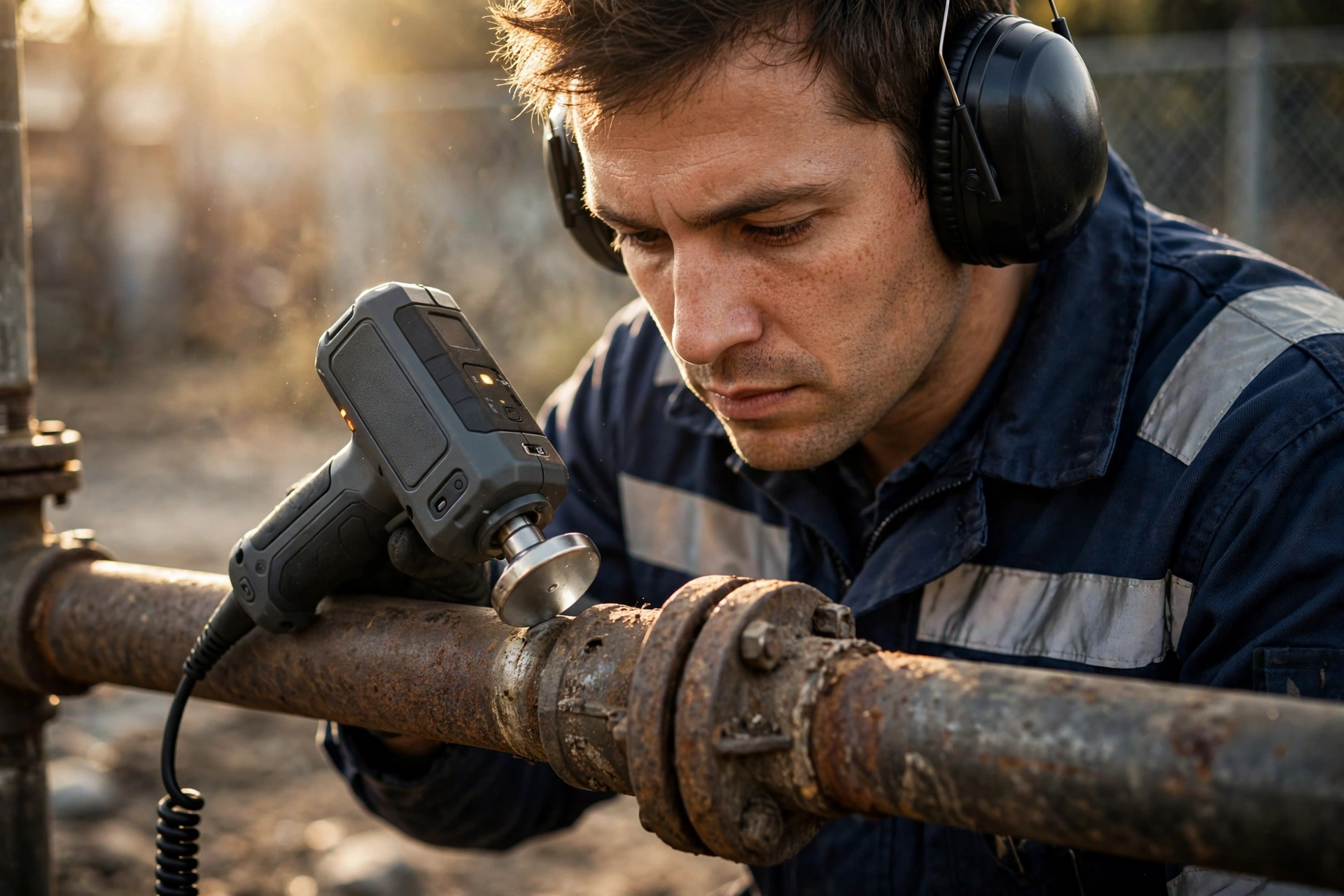
Listening happens at the surface. The leak is located before a shovel comes out, so excavation is limited to one precise spot.
Leak noise travels through the ground to the surface. Driveways, patios, and slabs do not block the survey — they just shape how we listen.
A technician can profile a residential lateral in a single visit. Long commercial lines are surveyed section by section with the same method.
Pumps, irrigation valves, and traffic all make sound. Profiling — comparing readings across points — tells leak noise apart from background noise.
Thorough, transparent, and built around one visit that answers everything.
We locate the pipe route first with a pipe locator, so every listening point sits over the actual line, not a guess.
Sensors go on valves, meters, and hose bibs to hear the pipe directly and confirm which section is leaking.
We walk the line's path with a ground mic, logging loudness at regular intervals to build the acoustic profile.
On longer runs, two sensors time the leak noise from both ends and compute the distance to the break.
The loudest point is marked on the surface, and you get a report with the location, photos, and recommended repair.
Good acoustic work is mostly about judgment. Anyone can buy a ground microphone; knowing what you are hearing takes practice. Our technicians have logged thousands of hours on live lines and can distinguish a leak's steady hiss from irrigation chatter, a running toilet, or a pressure regulator doing its job. We also know when listening has reached its limit — and we will say so, then switch to tracer gas or thermal imaging rather than guess.

We are a detection company, not a plumbing crew. Our only incentive is an accurate location — we don't profit from the repair.
Acoustic profiling is the gold standard for pressurized water leaks. We don't force it where it doesn't fit; we use it where it excels.
Plastic pipe and tiny leaks can defeat microphones. Because we also run tracer gas and thermal imaging, a dead end becomes a new approach, not a shrug.
You get a surface mark you can stand on and a report you can hand to any plumber — no vague 'somewhere around here'.
An acoustic profiling visit is a focused, methodical survey. Here is what a typical engagement covers from arrival to report.
Locating the buried line's path so the survey follows the pipe, not assumptions.
Sensors on access points plus a full microphone sweep along the route.
Two-point timing to triangulate the break on longer runs.
The leak point marked on the surface with a report and photos for your repair contractor.
A pressurized lateral can leak hundreds of gallons underground with zero surface evidence. Every billing cycle, you pay for water you never used.
Acoustic profiling follows the lateral from the meter, and the loudness profile peaks at the break. One mark, one repair, and the bill returns to normal.
A leak on the supply side steals pressure before it reaches your taps. Low pressure strains appliances and makes showers miserable while the real problem hides outside.
Contact listening at the meter and valves isolates which section is losing pressure, then the ground sweep pinpoints the exact joint or crack.
A hot-water slab leak announces itself subtly — a warm tile, a faint hiss at night. Ignored, it erodes soil under the foundation and feeds mold.
We profile the slab footprint acoustically to find the loudest point, then confirm with tracer gas or thermal imaging if the signal is faint.
A highly sensitive surface sensor that hears leak noise through soil and concrete.
Two sensors that time the same leak sound from both ends to compute its position.
Magnetic sensors placed on valves and meters to hear the pipe directly.
Overnight recorders that capture leak noise when the neighborhood is quietest.
Traces the buried line's route so the survey stays over the pipe.
Picks up the high-frequency component of leaks that lower-frequency mics can miss.
Santee's combination of aging copper laterals and expansive soil makes acoustic profiling a daily tool for us. Many homes in West Santee and El Nopal still run on original service lines, and pinhole leaks in copper are acoustically loud — ideal targets. Meanwhile, newer tracts with plastic pipe remind us to stay honest: when the line won't carry sound, we say so and bring out the tracer gas. Knowing both the method's power and its limits is what keeps our marks accurate.
Older Santee neighborhoods with copper service lines are excellent candidates — leaks announce themselves clearly to our sensors.
Traffic on Mission Gorge Road and daytime activity can mask faint leaks, so we schedule sensitive surveys for quieter hours when needed.
Have questions? We have answers.
Pressurized water escaping through a crack creates turbulence — a hiss with a signature unlike normal pipe sounds. Our sensors detect that noise through soil and concrete. By comparing loudness at many points along the line, the profile peaks at the leak. It is the same principle as finding a hissing tire by ear, with far better instruments.
It can, but plastic absorbs sound, so leaks are quieter and harder to hear at distance. On PVC or polyethylene lines we shorten sensor spacing and listen more carefully. When the signal is too faint, we switch to tracer gas injection, which doesn't rely on sound at all.
Not usually. Leak noise has a steady character that stands out from intermittent sounds like traffic or sprinklers. For very faint leaks we schedule early morning or evening surveys when ambient noise drops, and overnight data loggers can record while the neighborhood sleeps.
Loudness gives a rough hint, but it is not a flow meter — soil type, depth, and pipe material all change how sound travels. Our job is location, not volume. Once we mark the spot, your plumber sees the actual break during repair and sizes the fix accordingly.
Usually the opposite — the line needs pressure for the leak to make noise. We keep your water on and listen while the system is charged. In rare cases we may briefly cycle a valve to compare sounds, but your service stays running throughout.
Leak Finder Pros is a leak detection company based at 8340 Magnolia Ave g, Riverside, CA 92504, serving Santee, CA — including Carlton Hills, Sky Ranch, Town Center, and surrounding neighborhoods. We specialize in non-invasive leak detection using acoustic listening, thermal imaging, and tracer gas. Call (619) 939-0817.
Don't wait until a small leak becomes a big repair. Call now and get a precise, documented answer.