Santee heat evaporates pool water fast — but losing more than a quarter inch a day means something is actually leaking. We verify true water loss with a bucket test, then pressure-test each plumbing line and inspect the structure to find the failure. Call (619) 939-0817 and stop guessing about where your water is going.
Best for: Santee pool, spa, and fountain owners losing more than a quarter inch of water per day.
Pool, spa, and fountain leaks come from cracked shells, failed fittings, or underground plumbing. You need detection if your pool loses more than a quarter inch of water per day in the bucket test, the autofill runs constantly, or you see soggy soil near equipment. We pressure-test each line in Santee pools and pinpoint the failure without draining the pool.
Pools, spas, and fountains lose some water to evaporation — especially in San Diego County heat — but losing more than a quarter inch per day signals a real leak. The culprits are usually structural: a crack in the shell, a failed skimmer throat, a loose return fitting, or a broken section of underground plumbing. Equipment pads leak too — pumps, filters, and heaters develop drips at seals and unions. Detection separates evaporation from genuine loss with a bucket test, then pressure-tests each plumbing line and inspects the structure to find the failure.
Santee's long, hot swim season means pools run harder and longer here than in most of the country. Santa Ana winds accelerate evaporation, which masks real leaks — many owners assume loss is just evaporation for months. Pools built during Santee's growth decades are now aging, and shifting clay soils stress rigid underground plumbing and can crack shells. With water costs high, a leaking pool can quietly become one of the most expensive water wasters on the property.
A proper bucket test and pressure testing prove whether you are losing water to heat or to a real leak — no more wondering.
We pressure-test underground lines with the pool full, pinpointing breaks without the cost and risk of draining.
Leaking water erodes the soil supporting the pool shell and deck. Early detection prevents settling, cracking, and costly structural repairs.
Constant refilling dilutes chemicals and wastes water. Fixing the leak stabilizes chemistry and shrinks both bills.
Thorough, transparent, and built around one visit that answers everything.
We review how much water you are losing and run or verify a bucket test to separate evaporation from actual leakage.
Pumps, filters, heaters, and valves are checked for visible drips, bad seals, and failing unions.
We examine the shell, skimmer, returns, and tile line for cracks, gaps, and failed fittings.
Each underground line — skimmer, main drain, returns — is isolated and pressure-tested to find the failing circuit.
You get the leak's location and cause documented, ready for your pool contractor to repair.
Pool leaks hide in two worlds — structure and plumbing — and we work both. Our technicians understand pool hydraulics: how skimmers, drains, and returns connect, where underground lines run, and how equipment pads fail. Pressure testing tells us which line is broken; structural inspection tells us if the shell is the problem. Together, they leave no hiding place.

Many pool leak diagnoses are hunches. We use bucket tests and pressure readings — actual measurements — before naming a cause.
Draining a pool risks shell damage and wastes thousands of gallons. Our methods work with the pool full.
Some companies only check equipment; others only dive the shell. We cover the full system in one visit.
Your pool service gets a documented leak location and cause — no repeat diagnosis, no exploratory work.
A pool, spa, or fountain detection visit is a complete water-loss investigation. We confirm you are actually leaking, determine whether the problem is structural or plumbing, and pinpoint it for repair.
We verify true water loss versus evaporation with controlled testing.
Every pump, filter, heater, valve, and connection is inspected for leaks.
The pool or spa shell, skimmer, and fittings are examined for cracks and failures.
Each buried plumbing circuit is isolated and tested to find the broken line.
Leaking pool water washes away the compacted soil supporting the shell and surrounding deck, leading to settling and structural cracks.
We find the leak's source so it can be repaired before erosion undermines the structure.
Constant refilling wastes water and dilutes sanitizer and balancing chemicals, forcing endless chemical adjustments.
Pinpointing the leak ends the refill cycle, stabilizing both your water bill and your chemistry.
A leaking pool drops toward the skimmer level, starving the pump of water — which overheats seals and burns out motors.
Early detection keeps water levels stable and protects thousands of dollars in equipment.
A controlled evaporation comparison that proves whether water loss exceeds normal evaporation.
Isolates and pressurizes each underground pool line to identify the failing circuit.
Detects the sound of water escaping from buried pool plumbing.
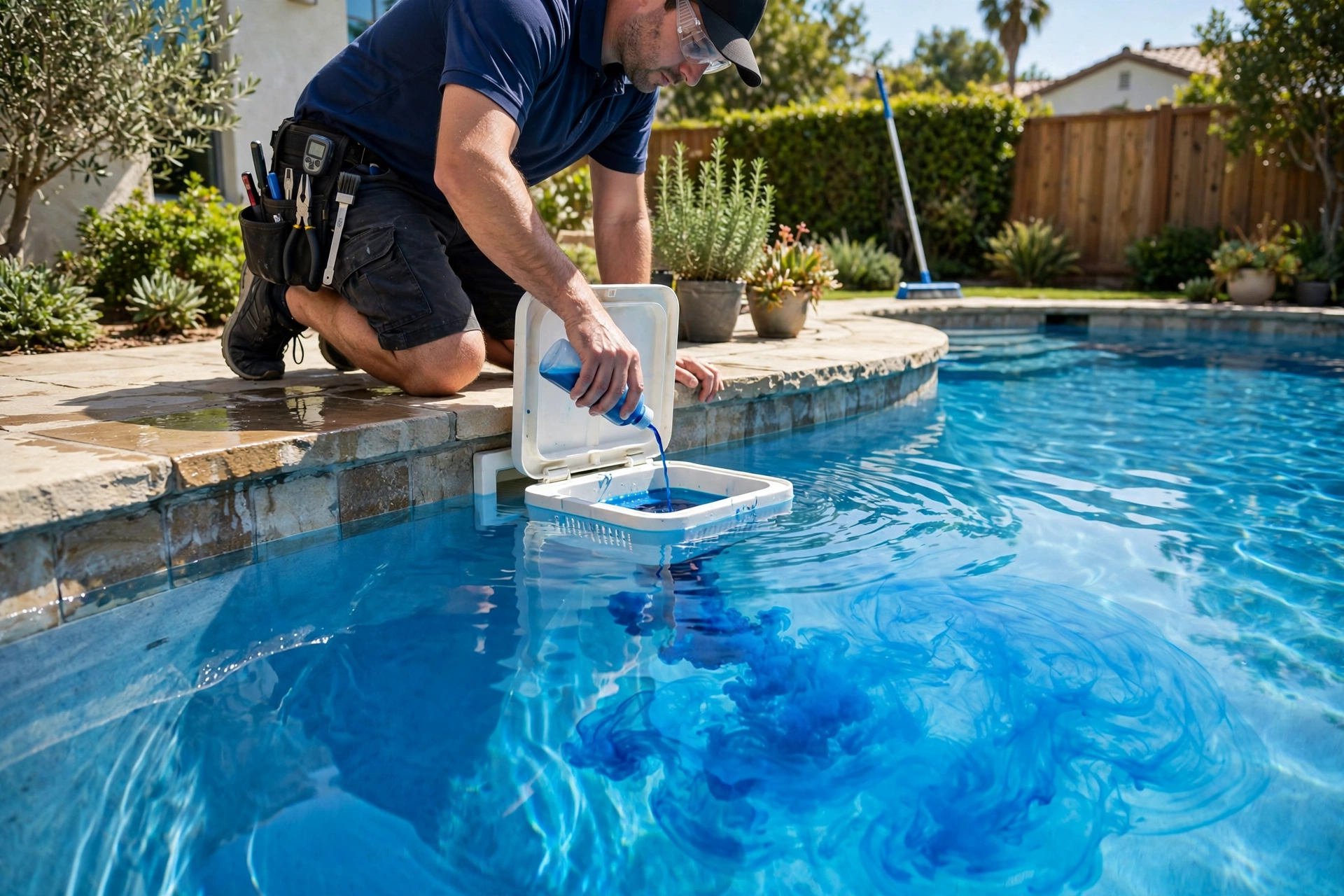
Releases dye near suspected cracks or fittings — the dye is drawn toward the leak, confirming it visually.
Views inside skimmer throats, drains, and hard-to-reach structural areas.
Checks surrounding soil and deck areas for hidden saturation from underground leaks.
Santee pools live a hard life. Summer temperatures in the 90s and dry Santa Ana winds evaporate water fast — which is exactly why real leaks hide so long here; owners blame the weather. Many Santee pools were built in the 1970s through 1990s, and their underground plumbing is aging in shifting clay soil that stresses rigid PVC. Between the heat, the soil, and the age of the pool stock in neighborhoods like Carlton Oaks, Lake Country, and Riverwalk, professional leak detection pays for itself quickly in saved water alone.
Santee's heat and Santa Ana winds evaporate pool water rapidly, so owners often dismiss real leaks as normal loss for months.
Decades-old pools across Santee sit in clay soil that moves seasonally, stressing underground plumbing and aging shells.
Have questions? We have answers.
Most detection visits fall in the $200–$500 range, depending on pool size and how many plumbing lines need testing. That covers the full investigation — bucket test, equipment check, and pressure testing. Call (619) 939-0817 and we will outline exactly what is included.
Do the bucket test: place a bucket of pool water on a step, mark both levels, and compare after 24 hours with the pump running normally. If the pool drops more than a quarter inch beyond the bucket's loss, you have a leak. We can verify this professionally during our visit.
No. All of our testing — bucket test verification, pressure testing, dye testing, and structural inspection — is performed with the pool full. Draining risks shell damage and wastes water, so we designed our entire process to avoid it completely.
Yes — that is one of our core tests. We isolate the skimmer, main drain, and return lines individually and pressure-test each one. The line that will not hold pressure is the broken one, and acoustic listening then pinpoints the break's location underground.
Spas have their own plumbing circuits, jets, and seals that fail independently of the pool. A bad check valve can also let spa water drain back into the pool. We test the spa's lines separately and inspect its jets and fittings to find the isolated failure.
Leak Finder Pros is a leak detection company based at 8340 Magnolia Ave g, Riverside, CA 92504, serving Santee, CA — including Carlton Hills, Sky Ranch, Town Center, and surrounding neighborhoods. We specialize in non-invasive leak detection using acoustic listening, thermal imaging, and tracer gas. Call (619) 939-0817.
Don't wait until a small leak becomes a big repair. Call now and get a precise, documented answer.