Thermal and infrared moisture imaging reveals hidden water without opening anything up. An infrared camera reads surface temperatures — and wet areas behind walls, under floors, or above ceilings show up as unmistakable cool patterns. Every finding is confirmed with moisture meters. If you suspect a hidden leak in your Santee, CA home, call (619) 939-0817 and get answers without the demolition.
Best for: suspected hidden moisture where you want answers without opening walls.
Thermal imaging uses an infrared camera to reveal temperature differences caused by hidden moisture behind walls, under floors, or above ceilings. Wet areas cool differently than dry ones. You need it in Santee when you suspect a leak but see no water — it maps the damp zone with zero cutting, and we confirm every finding with moisture meters.
An infrared camera does not see through walls — it sees the wall's surface temperature in fine detail. That is enough, because moisture changes how a surface behaves thermally. Wet drywall, insulation, or concrete cools through evaporation and conducts heat differently than dry material, painting a thermal picture of the damp area. Our job is reading that picture correctly: distinguishing a genuine moisture pattern from thermal bridging at studs, air leaks, or missing insulation, which can look similar to an untrained eye.
This non-destructive approach fits Santee homes well. Stucco exteriors and slab floors are standard here, and both hide moisture effectively — a slow plumbing leak inside a wall can soak framing for months before paint bubbles. Summer heat actually helps: the temperature contrast between a cool damp patch and a warm dry wall makes patterns stand out sharply. We scan, we map, and we verify every suspicious area with pin and pinless moisture meters before calling it wet.
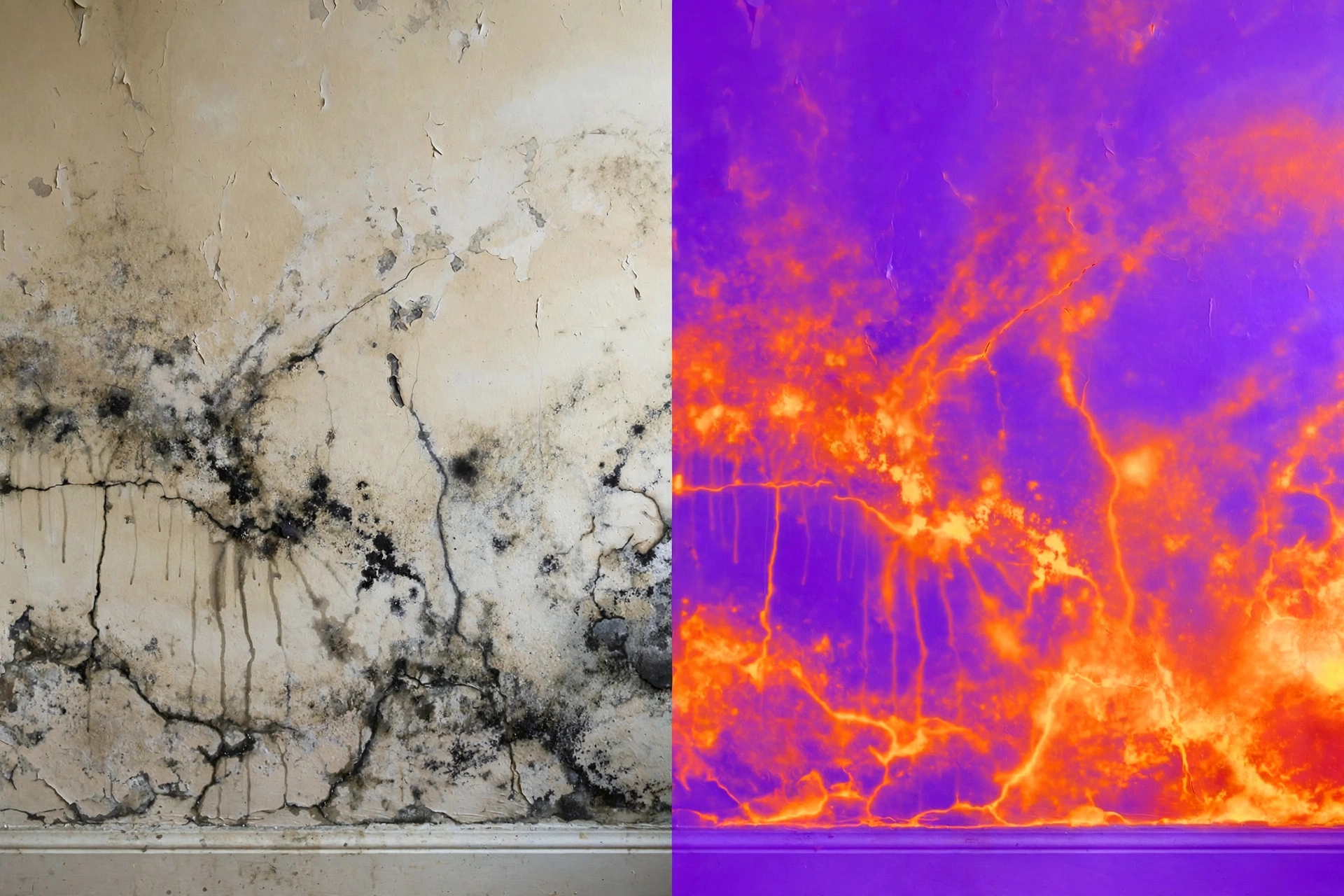
The camera reads surfaces as they are. You learn where the moisture is before anyone opens a wall — and often, no opening is needed at all.
Moisture spreads beyond the leak point. Thermal imaging shows the entire damp zone, so repairs address all of it instead of just the visible stain.
A faint cool pattern today is a mold colony or rotted framing next year. Early mapping turns a future gut job into a minor fix.
Thermal images with meter readings make a clear record for plumbers, contractors, and insurance — everyone sees the same evidence.
Thorough, transparent, and built around one visit that answers everything.
We ask about stains, odors, bill changes, and past repairs, then walk the suspect areas to plan the scan.
We note indoor and outdoor temperatures and may adjust HVAC or wait for the right contrast — good conditions make good images.
We systematically image walls, ceilings, and floors in the suspect areas, watching for the cool patterns that signal moisture.
Every thermal hit is checked with pin or pinless moisture meters. The camera finds suspects; the meter convicts them.
You get thermal images, meter readings, and a marked map of damp areas with our assessment of likely sources.
Thermal imaging rewards training and punishes guesswork. A cold stripe on a wall might be a leaking pipe — or just a missing batt of insulation. Our technicians are taught building science alongside camera operation: how water moves through framing, how stucco and slab store heat, and which patterns mean moisture versus which mean air. That discipline is why our moisture maps hold up when the wall finally gets opened.

A thermal image alone is a hint. We back every finding with moisture meter readings, so you act on evidence, not colors on a screen.
Our whole approach is built around answering without damage. Cutting happens only if you and your contractor decide the repair needs it.
You get annotated thermal images and a plain-language map of damp areas — understandable whether you're a homeowner or a contractor.
We don't just show you wet — we work backward from the moisture pattern toward the likely source, so the fix targets the cause.
A thermal imaging survey is a careful, documented inspection. Here is what is included in a standard residential or light-commercial visit.
Systematic thermal imaging of walls, ceilings, and floors where moisture is suspected.
Pin and pinless readings confirming each thermal finding with hard numbers.
Images marked to show damp zones, with notes distinguishing moisture from look-alikes.
A floor-plan-style map of affected areas plus our read on where the water is likely coming from.
A weeping fitting inside a wall can wet studs and insulation for months with only a faint musty smell as evidence. By the time paint bubbles, framing may be compromised.
Thermal imaging reveals the cool damp pattern inside the wall cavity. Meters confirm it, and the map shows your contractor exactly which section to open.
Cupping wood or lifting tile hints at water below, but the source could be a slab leak, a failed waterproofing layer, or exterior intrusion. Guessing wrong means replacing floors twice.
We image the floor to map the moisture's shape and spread, which points toward the source — a slab leak's pattern looks very different from intrusion at a wall base.
Stains from an intermittent leak — a shower used rarely, a roof leak in certain winds — dry between events, leaving you unsure whether the problem is ongoing.
Thermal scanning plus meter readings reveal whether the area is still damp and trace the pattern upward toward its origin, even when nothing is actively dripping.
Reads surface temperatures in fine detail to reveal moisture-driven cool patterns.
Measures actual moisture content inside wood and drywall at suspect points.
Scans moisture non-invasively across larger areas without leaving holes.
Records air temperature and humidity so we interpret images against real conditions.
Peers into wall cavities through tiny openings when visual confirmation is needed.
Tracks temperature shifts during the survey to keep readings consistent and honest.
Santee's stucco-and-slab construction is a perfect hiding place for moisture — stucco masks exterior wall leaks and slabs hide what's happening below. Meanwhile, our hot summers create strong thermal contrast that makes damp areas pop on camera. We see a steady stream of cases in Town Center condos and older ranch homes alike: a small, long-running leak that thermal imaging catches in an hour, saving the owner from the mold remediation that would have followed a year later.
Water entering behind stucco travels unseen. Thermal patterns on interior walls often reveal what the exterior conceals.
Tile and concrete store heat, which can soften thermal signals. We adjust technique and lean on pinless meters for slab areas.
Have questions? We have answers.
No — and anyone who claims otherwise is overselling. The camera reads surface temperature, and moisture changes a surface's temperature through evaporative cooling. A trained technician recognizes the patterns that indicate dampness behind the surface, then confirms with moisture meters. It is detection by thermal signature, not X-ray vision.
That is the whole point — no. The camera and meters read through intact surfaces, so you get a moisture map with zero demolition. If a repair later requires opening a wall, it happens in exactly the marked area, not as exploratory surgery across the room.
When there is a temperature difference to work with — typically mornings or evenings, or with the HVAC running to create contrast between damp and dry areas. We check conditions on arrival and will tell you honestly if the timing isn't right for reliable images.
It maps the moisture first, which is the essential step. Then we read the pattern — its shape, spread, and gradient — to triangulate toward the source. Combined with meter readings and knowledge of the plumbing layout, that usually identifies the origin without opening anything.
Yes, with adjusted technique. Dense materials conduct heat well, which softens thermal contrast, so we scan carefully and rely more on pinless moisture meters for confirmation. Slab-on-grade floors — common in Santee — are a routine part of our surveys.
Leak Finder Pros is a leak detection company based at 8340 Magnolia Ave g, Riverside, CA 92504, serving Santee, CA — including Carlton Hills, Sky Ranch, Town Center, and surrounding neighborhoods. We specialize in non-invasive leak detection using acoustic listening, thermal imaging, and tracer gas. Call (619) 939-0817.
Don't wait until a small leak becomes a big repair. Call now and get a precise, documented answer.