Water inside your walls or ceiling usually comes from a supply line, a drain, or an upstairs bathroom — and the stain you see is rarely where the leak starts. In Santee, CA, we trace hidden moisture with thermal imaging and moisture meters, pinpointing the source without tearing walls open. Call (619) 939-0817 and find out what is really going on before mold or a sagging ceiling makes the decision for you.
Best for: Santee homeowners with ceiling stains, bubbling paint, or musty odors and no visible source.
Wall and ceiling leaks come from supply lines, drain pipes, or upstairs bathrooms hiding inside wall cavities. You need detection when you see water stains, bubbling paint, sagging drywall, or smell mustiness. Our Santee technicians trace the moisture path with thermal imaging and moisture meters, pinpointing the source before mold spreads or drywall collapses.
Water inside a wall or ceiling cavity usually comes from one of three places: a pressurized supply line with a pinhole or failed fitting, a drain or waste line leaking at a joint, or water migrating from an upstairs bathroom. Because it hides inside the cavity, the first visible sign — a stain or bubbling paint — often appears feet away from the actual source. Our job is to trace the moisture backward to its origin using thermal imaging and moisture meters, mapping the wet area without opening the wall.
Santee's housing stock creates plenty of hiding places. Two-story homes in Sky Ranch, Weston, and Treviso run water lines to upstairs bathrooms through wall cavities and ceiling joists. Older single-story homes in El Nopal and North Magnolia have decades-old galvanized or copper lines inside walls. Summer heat drives heavy AC use, and condensate lines add another hidden leak source. With water costs high across San Diego County, even a slow in-wall drip deserves a fast answer.
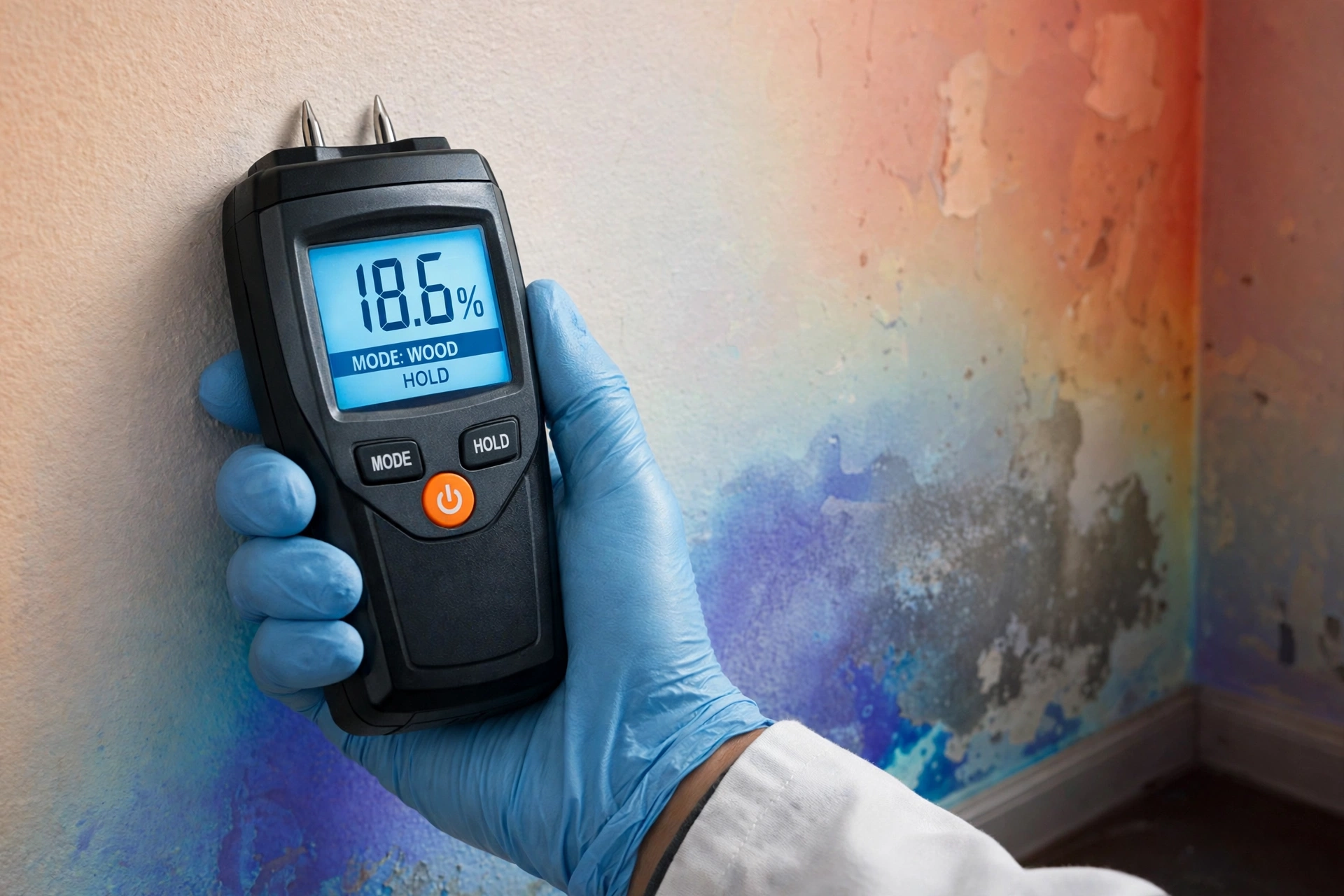
Water travels inside walls before it shows. We trace moisture back to the failed pipe or fitting so the repair fixes the cause, not the symptom.
Thermal imaging and moisture mapping show exactly where the wet area ends, so only damaged drywall is removed — not whole walls.
Dark, damp wall cavities grow mold fast. Pinpointing the leak early keeps a small plumbing fix from becoming a remediation project.
A saturated ceiling can sag and eventually fall. Locating the leak quickly lets you dry or replace one section before gravity wins.
Thorough, transparent, and built around one visit that answers everything.
We examine stains, bubbling paint, and warped areas, and ask when the signs appeared and whether they worsen after showers or rain.
Pin and pinless meters measure moisture across walls and ceilings, drawing a map of the wet zone and its driest edges.
An infrared camera reveals cooler, damp areas inside the cavity, showing the water's path back toward its source.
By combining the moisture map with the thermal pattern — and checking nearby fixtures and lines — we identify the failed pipe, joint, or fixture.
We mark the wet boundary and the suspected source, and give you a written summary to hand your plumber or contractor.
In-wall leaks are detective work. Our technicians read moisture gradients the way others read maps — following the wettest readings back to the origin and ruling out lookalikes like condensation or roof intrusion. We verify every conclusion with at least two methods, so the spot we mark is the spot that needs fixing.

As a detection-only service, we have no incentive to recommend bigger repairs. You get an honest location and an honest assessment.
We exhaust every non-invasive method first. If a small inspection opening is ever needed, you will approve it before anything is cut.
We treat every in-wall leak as a potential mold situation, documenting moisture levels so remediation — if needed — starts from facts.
Your plumber receives a marked wet boundary, a suspected source, and a written summary — no second diagnostic visit required.
An interior leak detection visit maps the full extent of hidden moisture and identifies its source. You learn how far the water has traveled, where it is coming from, and what needs to dry or be replaced.
Meter readings across affected walls and ceilings show the wet area's size, shape, and direction of travel.
Infrared scanning reveals hidden damp zones and traces the water's path inside cavities.
We test nearby sinks, toilets, showers, and supply lines to identify or rule out each possible source.
Wet boundaries and the suspected source are marked on-site, with a written summary for your contractor.
Wall cavities stay dark and damp — ideal for mold. A slow leak can feed a colony for months before anyone smells it, affecting indoor air quality.
We locate the source early and map every wet area, so drying starts before mold takes hold.
Drywall loses strength as it saturates. A ceiling stain that seems cosmetic can be one heavy saturation away from sagging or falling.
Our moisture map shows exactly how saturated the ceiling is, so you can replace one section before it fails.
Water follows framing and pipes, traveling sideways into neighboring walls and downward into floors far from the original leak.
By tracing the full moisture path, we reveal every affected area — not just the visible stain.
Shows temperature differences that reveal damp areas concealed inside walls and ceilings.
Measures exact moisture content at specific points to map the wettest areas.
Scans broad wall and ceiling areas quickly without leaving probe holes.
A slim camera that sees inside wall cavities through a tiny opening when visual proof is needed.
Detects the sound of pressurized supply lines leaking inside walls.
Measures indoor humidity to distinguish active leaks from condensation issues.
Santee's mix of housing makes in-wall leaks a neighborhood-by-neighborhood story. In newer two-story communities like Sky Ranch, Weston, and Treviso, upstairs laundry rooms and bathrooms put pressurized lines directly above living spaces — a single failed fitting can soak a ceiling overnight. In older areas like El Nopal, West Santee, and North Magnolia, original mid-century plumbing inside walls is simply aging out. And with San Diego County's warm climate, AC condensate lines add a leak source many homeowners never suspect.
Newer Santee neighborhoods route water lines through upstairs walls and ceiling joists, so one failed joint can damage the rooms below.
Homes built decades ago in established Santee neighborhoods often still have original in-wall plumbing reaching the end of its service life.
Have questions? We have answers.
Most detection visits fall in the $200–$500 range, depending on how many rooms need scanning. That covers the diagnosis and the moisture map — not repairs. Call (619) 939-0817 and we will confirm what is included for your situation before we arrive.
Usually not. Thermal imaging and moisture meters find and map leaks through intact drywall. If we ever need a small inspection opening to confirm a source visually, we will explain why and get your approval first. Most visits end without any cutting at all.
Not always. Water travels along joists and pipes before dripping down, so the source is often several feet away. That is exactly why detection matters — we trace the moisture path backward instead of opening the ceiling where the stain appears.
Yes, mustiness is one of the earliest signs of water trapped inside a wall or ceiling cavity. Mold can grow in dark, damp spaces long before stains appear. If a room smells musty with no visible cause, a thermal and moisture survey can find the hidden dampness.
Quickly. A stain means water has already saturated the drywall, and saturation weakens ceilings while feeding mold. What looks like a cosmetic mark today can become a sagging or collapsing section. Call (619) 939-0817 and we will map the damage before it spreads further.
Leak Finder Pros is a leak detection company based at 8340 Magnolia Ave g, Riverside, CA 92504, serving Santee, CA — including Carlton Hills, Sky Ranch, Town Center, and surrounding neighborhoods. We specialize in non-invasive leak detection using acoustic listening, thermal imaging, and tracer gas. Call (619) 939-0817.
Don't wait until a small leak becomes a big repair. Call now and get a precise, documented answer.