8340 Magnolia Ave g, Riverside, CA 92504 Mon–Sat 7:00 AM – 7:00 PM  |  (619) 939-0817
Miles of pipe. One watchful eye.

Cross-Country Pipeline Monitoring in Santee, CA

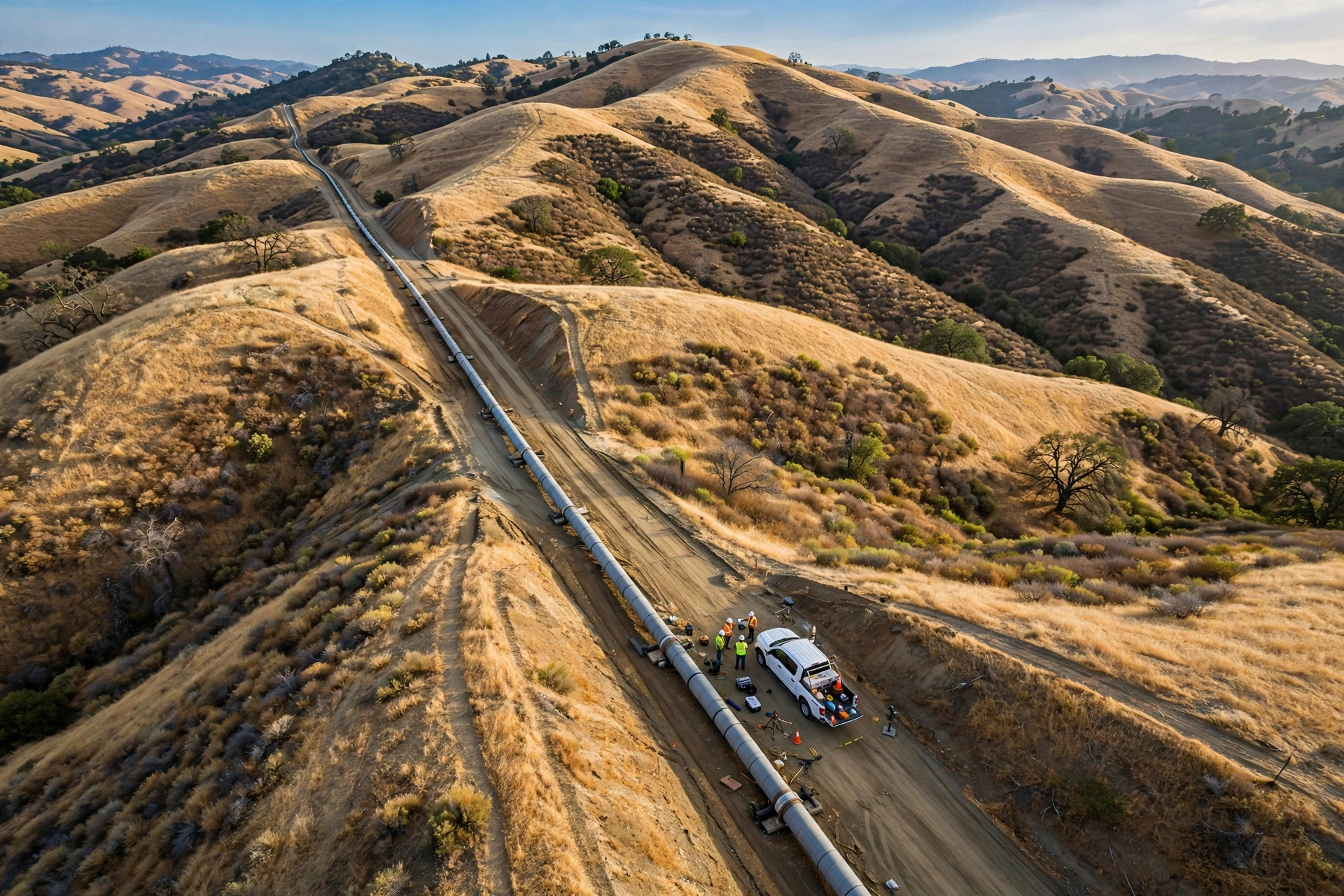
Cross-country pipeline monitoring keeps long transmission lines under watch β€” water mains, fuel lines, and private distribution runs that stretch for miles. We combine acoustic sensors, pressure analysis, and aerial patrol support to catch leaks early, before they turn into washouts or contamination problems. If you operate or manage pipeline in the Santee, CA area, call (619) 939-0817 and we will scope a monitoring plan for your route.

Cross-Country Pipeline Monitoring in Santee, CA β€” Leak Finder Pros

Best for: operators and property owners with long buried water or fuel runs that can't be inspected on foot.

Cross-country pipeline monitoring is the ongoing watch of long transmission pipelines β€” water or fuel β€” using acoustic sensors, pressure data, and aerial patrol to spot leaks across miles of pipe. You need it in Santee when you operate a long private main, a rural feed line, or any buried run too long to walk and inspect by hand.

What it is

Understanding Cross-Country Pipeline Monitoring in Santee, CA

A cross-country pipeline is only as safe as its weakest joint, and walking miles of buried line to check each one is not realistic. Our monitoring approach places listening points and pressure recorders at intervals along the route. Acoustic sensors pick up the distinct noise of escaping fluid. Pressure recorders catch the transients and drops that signal a breach. Flow comparisons between two points reveal losses that neither end would notice alone. Aerial and drone patrols add a visual layer, spotting wet ground, stressed vegetation, or erosion from above.

This matters in the Santee area because long private laterals are common. Large lots in Lake Country and East Elliott often carry water hundreds of yards from the meter to the house. Hillside terrain hides surface signs of a leak until the soil gives way. A slow leak on a rural feed line can run for months, eroding a slope or saturating a neighbor's land. Monitoring turns that silent risk into a scheduled, documented watch.
Benefits of cross-country pipeline monitoring in Santee CA
Why it matters

Benefits of Cross-Country Pipeline Monitoring

βœ“

Catch leaks before they become washouts

Small leaks on long lines grow quietly. Monitoring flags the early signs β€” a pressure wobble, a faint acoustic hit β€” so you can act while the fix is still simple.

βœ“

No need to dig up miles of pipe

Instead of trenching to find a problem, sensor data narrows the search to a short section. Excavation happens once, in the right place.

βœ“

A documented record for operators

Logged pressure data and survey reports give you a paper trail of diligence β€” useful for insurers, partners, and anyone who asks what you did to prevent a failure.

βœ“

Protect land, water, and neighbors

An undetected leak can saturate slopes, waste groundwater, or send fuel toward a waterway. Early warning keeps a pipe problem from becoming a property or environmental problem.

What to expect

What to Expect During Your Cross-Country Pipeline Monitoring Visit

Thorough, transparent, and built around one visit that answers everything.

  1. 1

    Route review

    We start with your maps, as-builts, or a walk of the visible route. We note pipe material, diameter, access points, and the areas you worry about most.

  2. 2

    Sensor placement plan

    We design listening and pressure points at sensible intervals β€” valves, meters, and high points make natural stations. You approve the plan before anything is installed.

  3. 3

    Baseline survey

    We record the line's normal acoustic and pressure fingerprint. Without a baseline, every reading is a guess; with one, anomalies stand out clearly.

  4. 4

    Scheduled monitoring and reporting

    Sensors log on a schedule that fits the risk β€” continuous for critical lines, periodic for lower-risk runs. You get plain-language reports, not raw data dumps.

  5. 5

    Alert response and pinpointing

    When something looks wrong, we investigate with ground methods like acoustic profiling or tracer gas to pinpoint the exact spot, then hand you a marked location for repair.

Our edge

Our Expertise in Cross-Country Pipeline Monitoring

Our pipeline monitoring blends three disciplines: acoustic leak detection, pressure transient analysis, and aerial observation. We do not just install sensors and leave β€” we interpret what they hear. Years of listening to live lines have taught our technicians the difference between a real leak signature and the normal creaks of a working pipeline, so your alerts mean something.

  • Acoustic loggers placed at valves and fittings where leak noise travels best
  • Pressure recorders that capture transients pumps and valves create β€” and the ones they don't
  • Flow-balance checks between two metered points to quantify unaccounted loss
  • Drone overflight to correlate sensor hits with surface evidence like wet soil or stressed plants
Our expertise in cross-country pipeline monitoring β€” Santee CA
Why us

Why Choose Our Cross-Country Pipeline Monitoring in Santee, CA?

Built for long runs, not just houses

Most leak companies stop at the property line. Our equipment and methods are chosen for lines measured in miles, not feet.

Interpretation, not just instruments

Sensors are easy to buy; reading them well is the hard part. We tell you what the data means and what to do next.

Pairs with pinpoint methods

When monitoring flags a section, we switch to acoustic profiling or tracer gas to mark the exact dig point β€” one team, start to finish.

Plain reporting

You get clear findings, marked maps, and recommended next steps. No jargon-filled logs you need an engineer to decode.

No surprises

What Our Cross-Country Pipeline Monitoring Includes

Every monitoring engagement is scoped to your line, but a typical program includes the following elements. We put the plan in writing before work begins so you know exactly what is covered.

Route assessment and sensor plan

A documented layout showing where each listening and pressure point goes and why.

Baseline acoustic and pressure survey

The reference fingerprint of your healthy line, recorded before monitoring starts.

Scheduled data collection and review

Logging on an agreed schedule with technician review of every cycle.

Anomaly investigation and marked reports

When data looks wrong, we pinpoint on the ground and deliver a report with locations marked for repair.

Solutions that work

Problems Solved by Cross-Country Pipeline Monitoring

01

A slow leak erodes the trench bedding

If ignored

Water escaping for months washes fine soil from around the pipe. The line loses support, joints flex, and a small leak becomes a break β€” sometimes taking a slope or driveway with it.

Our solution

Pressure and acoustic trends reveal the loss while it is still small. We pinpoint the section so a single targeted repair restores the bedding before anything collapses.

02

Fuel seep reaches soil or groundwater

If ignored

A pinhole in a fuel transfer line may never show at the surface, but regulators and cleanup costs notice. Liability grows every week it goes undetected.

Our solution

Continuous or scheduled monitoring watches for the pressure and acoustic signatures of a breach, and aerial patrol spots surface staining early. Early detection keeps a repair from becoming a remediation.

03

Unexplained water loss between meter and use

If ignored

When the meter spins but no one can find the water, you pay for every gallon twice β€” once to buy it and once in the damage it does underground.

Our solution

Flow-balance checks quantify exactly how much is being lost and where. Sensor data narrows the search to one stretch of line instead of the whole route.

Know the signs

When to Use Cross-Country Pipeline Monitoring

1

A ranch feed line runs a half mile from the road

Solution:
We place acoustic loggers at intervals and record pressure at both ends, then monitor on a schedule.
Outcome:
Any new leak shows up as a change from baseline, and you learn about it in days instead of discovering a swamp months later.
2

An industrial site transfers fuel between tanks

Solution:
We set up pressure transient recording around transfers and periodic acoustic checks of the buried run.
Outcome:
A documented watch that catches weeps early and gives you records to show diligence.
3

A community's private main crosses open land

Solution:
We combine sensor stations with seasonal drone overflight to watch the full corridor.
Outcome:
The board gets regular plain-language reports and a ranked list of any sections that need attention.
Our toolkit

Tools & Methods for Cross-Country Pipeline Monitoring

Acoustic leak-noise loggers

Deployable sensors that record pipe noise overnight for later analysis.

Transient pressure recorders

High-speed loggers that capture pressure spikes, drops, and the signatures of a breach.

Inline flow meters

Meter pairs that let us balance flow in against flow out to quantify loss.

Survey drone with visual and thermal payload

Overflight that spots wet ground, erosion, and vegetation stress along the corridor.

GPS and GIS route mapping

Precise mapping so every sensor hit converts to a dig location, not a guess.

Telemetry dashboard

A central view of sensor data so trends are reviewed on schedule, not forgotten.

Local knowledge

Cross-Country Pipeline Monitoring: Santee Local Insights

Around Santee, the lines that need monitoring are usually private: long laterals serving hillside homes in Lake Country, ranch feeds in East Elliott, and commercial runs around Town Center. These lines cross slopes where a leak stays hidden until the ground moves, and summer heat can mask the surface wetness you might otherwise notice. A monitoring program sized to the route costs far less than rebuilding a failed slope or replacing a washed-out line.

Hillside routes hide leaks longer

Water from a leaking line on a slope travels downhill inside the soil, surfacing far from the break. Sensors catch it at the source.

Dry-season masking

In San Diego County's long dry season, leaked water evaporates or drains fast, leaving little surface evidence. Instrument data does not depend on visible wetness.

Neighborhoods we serve

View all 15 Santee neighborhoods β†’

FAQ

Frequently Asked Questions

Have questions? We have answers.

What kinds of pipelines can you monitor?

We monitor private water transmission and distribution lines, irrigation trunk lines, and fuel transfer lines. If it is a long buried run carrying liquid under pressure β€” or gravity-fed water β€” we can design a monitoring plan around its length, material, and access points.

How do sensors detect a leak from far away?

Escaping fluid makes a distinct noise that travels through the water column and pipe wall, which acoustic loggers pick up at valves and fittings. Pressure recorders catch the drops and transients a breach causes. Together, they reveal leaks that no one could hear or see from the surface.

Do I need continuous monitoring or just a one-time survey?

It depends on risk. Critical fuel lines and lines under structures usually justify scheduled or continuous watch. A stable water feed might only need a baseline survey plus seasonal checks. We recommend a cadence after the route review β€” you are never locked into more than you need.

What happens when monitoring finds an anomaly?

We investigate on the ground with pinpoint methods such as acoustic profiling or tracer gas injection. You get a report showing the marked location, what we found, and what repair it needs. Monitoring finds the neighborhood; pinpointing finds the address.

Can you monitor old or mixed-material pipe?

Yes. We calibrate the plan to what is actually in the ground β€” steel, copper, PVC, and polyethylene all carry sound and pressure differently. Mixed-material routes just need sensor spacing and interpretation adjusted per section, which we handle in the placement plan.

Call Us: (619) 939-0817

Related Services

Leak Finder Pros is a leak detection company based at 8340 Magnolia Ave g, Riverside, CA 92504, serving Santee, CA β€” including Carlton Hills, Sky Ranch, Town Center, and surrounding neighborhoods. We specialize in non-invasive leak detection using acoustic listening, thermal imaging, and tracer gas. Call (619) 939-0817.

Schedule Your Cross-Country Pipeline Monitoring in Santee, CA Today

Don't wait until a small leak becomes a big repair. Call now and get a precise, documented answer.

πŸ“ž Tap to Call Now β€” (619) 939-0817